

How to Start a Financial Wellness Journaling Challenge
Last Updated: November 14, 2026
Quick Summary
A financial wellness journaling challenge is a short, structured series of daily writing prompts and small money actions designed to change how you think about and handle money. Our 30-day challenge runs in four weekly stages: awareness and assessment, budgeting and spending habits, saving and debt, then stewardship and long-term vision. Each day pairs one reflection prompt with one small money action, taking 10 to 20 minutes.
- Week 1 focuses on awareness and assessment, with 10-15 minutes of daily reflection and small assessment tasks.
- Track every purchase for seven days during Week 2 to see where your money actually goes.
- Record a baseline before Day 1, then measure the same numbers again on Day 30.
- The 50/30/20 rule splits income into 50% needs, 30% wants, and 20% savings and debt payoff.
- After Day 30, keep a daily five-minute habit and a weekly 15-minute review.
Table of Contents
- Why a Financial Wellness Journaling Challenge Changes Your Money Story
- Your 30-Day Financial Wellness Challenge: A Week-by-Week Roadmap
- Financial Wellness Journal Prompts for Every Stage of the Challenge
- How to Build Your Own Financial Wellness Journaling Challenge Template
- Financial Wellness Activities to Pair With Your Journaling
- Adapting the Challenge to Your Season of Life
- Start Your Challenge With the Money Matters Journal
- Frequently Asked Questions
Why a Financial Wellness Journaling Challenge Changes Your Money Story
A financial wellness journaling challenge is a short, structured series of daily writing prompts and small money actions designed to change how you think about and handle money.

At IndiWrites, we built our Money Matters journal around the belief that faith and money are closely connected.
Below is a full 30-day financial wellness challenge, week by week, with prompts you can start using today.
What the Research Says About Financial Stress
The numbers are sobering. NEFE's January 2026 poll found that 8 in 10 Americans were concerned about their finances heading into 2026. Acorns reports that 45% of Americans have felt anxiety from financial pressure.
The Financial Health Network's Financial Health Pulse 2026 report shows the share of financially vulnerable U.S. households rose from 15% to 17% in a single year.
Money stress is not a character flaw. It is a common burden that can ease with steady, small habits.
How Journaling Rewires Your Money Mindset
A journal can help you notice the beliefs you carry about money. Maybe you grew up hearing "we can't afford that." Maybe you believe your income defines your worth.
If journaling is new to you, our guide on how to start journaling for Christian growth walks you through the first steps. For a deeper look at renewing your mind through Scripture, read biblical ways to renew your mind.
Your 30-Day Financial Wellness Challenge: A Week-by-Week Roadmap
Here is a 30-day financial wellness challenge in four weekly stages, each with a daily reflection prompt and a small money action.
| Week | Focus | Daily Time | Key Outcome |
|---|---|---|---|
| Week 1 | Awareness and assessment | 10-15 minutes | Know where you stand |
| Week 2 | Budgeting and spending habits | 15 minutes | See where money goes |
| Week 3 | Saving, debt, and planning | 15-20 minutes | Build a plan you can keep |
| Week 4 | Stewardship and long-term vision | 15 minutes | Set a direction for the year |
Daily Time
Week 1: Awareness and Assessment (Days 1-7)
Days 1-7 are about honesty, not action. You cannot fix what you have not faced. Each day pairs one reflection prompt with one small assessment task.
- Day 1, Prompt: What is my earliest memory about money? Action: List your monthly income from every source.
- Day 2, Prompt: What did I learn about money as a child? Action: List your fixed expenses (rent, utilities, insurance, subscriptions).
- Day 3, Prompt: What do I believe about people who are "good with money"? Action: Write down every account balance you currently hold.
No shame here. Just observation.
Week 2: Budgeting and Spending Habits (Days 8-14)
Days 8-14 turn the lens toward your daily choices. Track every purchase for seven days.
- Day 8, Prompt: Which purchase this week brought me real joy? Action: Set up a simple spending log (paper or app).
- Day 9, Prompt: Which purchase did I regret within a day? Action: Log every purchase, no matter how small.
- Day 10, Prompt: What emotion was I feeling before my last unplanned purchase? Action: Continue logging; note the emotion beside each entry.
Week 3: Saving, Debt, and Planning (Days 15-21)
Days 15-21 focus on the future. Set a short-term savings goal, a long-term one, and a realistic emergency fund target.
- Day 15, Prompt: How does my debt affect my peace of mind? Action: Write out each debt balance and its interest rate.
- Day 16, Prompt: What would a fully funded emergency fund make possible for me? Action: Set a specific emergency fund target (for example, one month of essential expenses).
- Day 17, Prompt: What is one small step I can take toward my savings goal this week? Action: Automate a transfer, even a small one, to savings.
Planning without feeling misses half the picture.
Week 4: Stewardship and Long-Term Vision (Days 22-30)
The final week connects your money to your faith and your purpose.
- Day 22, Prompt: What does generosity look like for me right now? Action: Choose one giving goal for the month.
- Day 23, Prompt: How do I want to use my money to serve others this year? Action: Identify one cause or person to support.
- Day 24, Prompt: What does financial freedom mean in my current season? Action: Write a one-sentence definition of financial freedom for you.
End the challenge by writing a letter to yourself about the next 90 days. What will you keep doing?
Financial Wellness Journal Prompts for Every Stage of the Challenge
These financial wellness journal prompts match each week of the challenge. Use one per day, or repeat the ones that stir something in you.
Prompts for Week 1: Uncovering Money Beliefs
- What is my earliest memory about money?
- What did my parents teach me about spending, saving, and giving?
- When do I feel most anxious about money?
Prompts for Week 2: Tracking Spending and Budgeting
- Which purchase this week brought me real joy?
- Which purchase did I regret within a day?
- What emotion was I feeling before my last unplanned purchase?
Prompts for Week 3: Debt, Savings, and Emergency Funds
- How does my debt affect my peace of mind?
- What would a fully funded emergency fund make possible for me?
- What is one small step I can take toward my savings goal this week?
Prompts for Week 4: Future Planning and Generosity
- What does generosity look like for me right now?
- How do I want to use my money to serve others this year?
- What does financial freedom mean in my current season?
How to Build Your Own Financial Wellness Journaling Challenge Template
A good financial wellness journaling challenge template has four parts and takes about ten minutes a day. A notebook and a pen will do. If you are weighing whether a guided journal is worth the money, our article on guided journals for intentional living covers what to look for.
The Four-Part Daily Page
- A Scripture or truth to anchor the day. One verse, written out by hand.
- A prompt to answer. One question, answered honestly in a few sentences.
- A number to record. Today's spending, or your current balance.
- A prayer or intention. One sentence handing the day to God.
That structure keeps you grounded in both the practical and the spiritual.
Baseline and End-of-Challenge Measures
Before Day 1, record a simple baseline so you can measure change. At the end of Day 30, record the same measures again.
| Measure | Baseline (Day 1) | End of Challenge (Day 30) |
|---|---|---|
| Total monthly spending | $______ | $______ |
| Amount saved this month | $______ | $______ |
| Number of unplanned purchases | ______ | ______ |
| Confidence about money (1-10) | ______ | ______ |
| Peace about money (1-10) | ______ | ______ |
Weekly Review and Progress Tracking
Every seventh day, review the week. Ask three questions:
- What did I learn about my spending this week?
- Where did I see progress?
- What will I do differently next week?
Track your progress in simple measures: total spending, amount saved, and a one-to-ten score for how peaceful you felt about money.
A Simple Maintenance Plan After Day 30
The challenge ends, but the routine should not. Choose one prompt and one action to keep. A sustainable plan looks like this:
- Daily (5 minutes): Record today's spending and one sentence about how you felt about money.
- Weekly (15 minutes): Answer the three weekly review questions and update your tracker.
- Monthly (30 minutes): Recalculate your baseline measures and compare them to last month.
Keep the daily number and the weekly review, and let the rest flex as your season allows.
Adapting the Template to Different Financial Situations
One budget or savings approach does not fit everyone. Adjust the template to your circumstances:
- Irregular income: Track income by month and use a range for your baseline rather than a single number. Focus prompts on smoothing expenses between high and low months.
- Carrying debt: Replace the savings goal with a debt-payoff goal for Week 3, and journal about how the debt affects your peace of mind, not just its cost.
- Limited savings: Set a starter emergency fund target of one week of essential expenses, then build from there.
Privacy and Emotional Safety
Keep your notes private: use a locked drawer, a password-protected file, or a journal you keep in a safe place. If a prompt brings up something painful, you can stop, write one sentence, and return later. A journal is a tool, not a replacement for professional help.
Financial Wellness Activities to Pair With Your Journaling
Journaling works best when it sits alongside real action. These financial wellness activities take little time and build momentum.
The 50/30/20 Rule and the 3-2-1 Method
The 50/30/20 rule splits your income into three buckets: 50% for needs, 30% for wants, and 20% for savings and debt payoff. It is simple enough to remember and flexible enough to adjust.
The 3-2-1 method is a lighter daily practice: three things you are grateful for, two financial wins from the day, and one money decision to make tomorrow.
Write both into your journal and watch how your mindset shifts over the month.
No-Spend Days and Spending Audits
Pick one day a week as a no-spend day. No coffee run, no online cart. Pack a lunch instead. Then journal about how it felt.
A monthly spending audit works the same way. Go through every expense and ask: was this worth it? Cancel what was not.
Adapting the Challenge to Your Season of Life
Not every season allows the same pace. The challenge should bend to fit your life, not the other way around.
When You Are Grieving or Emotionally Exhausted
Grief and money stress often arrive together. If you are in a dark place, lower the bar.
Skip the deep financial audit for now. Our guide on how to process grief through prayer offers a softer path alongside the challenge.
A journal is a tool, not a replacement for professional help.
When You Are Single or in Transition
Single women and women in transition often carry every financial decision alone. That makes this challenge more valuable, not less.
Use the prompts to clarify what you actually want, not what others expect. Write about your dream job, your ideal lifestyle, and the income you would need to support both.
Your finances are yours to steward. That is a gift, not a burden.
Start Your Challenge With the Money Matters Journal
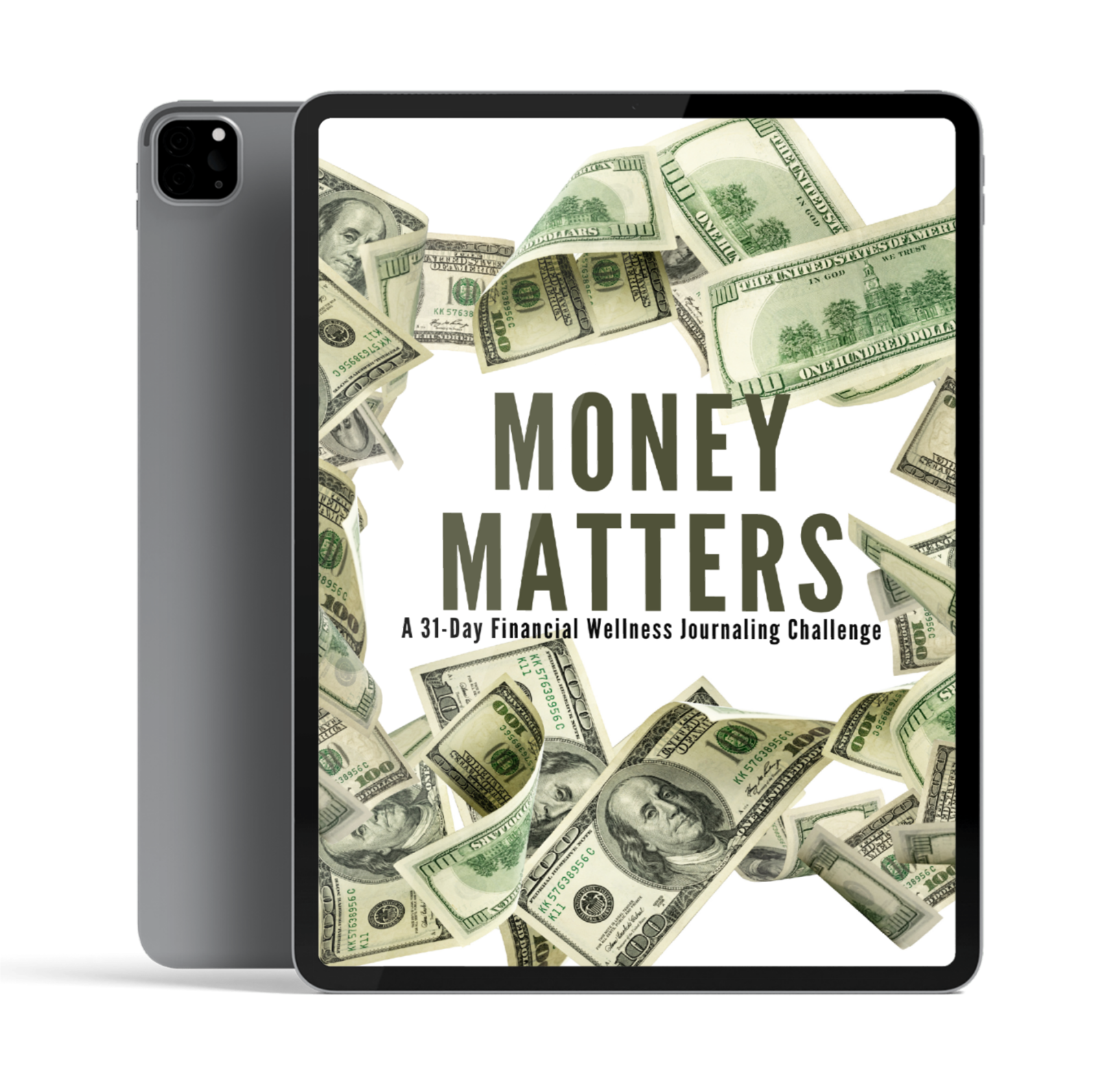
Thirty days of honest reflection can change how you see every dollar. The challenge you just read is exactly what our Money Matters 31-day financial wellness journaling challenge ebook was built to guide you through, day by day, with Scripture and practical exercises woven together.
You do not need to feel ready. You just need to start.
Money stress can feel like a weight you carry alone. It does not have to stay that way.
Frequently Asked Questions
What is a financial wellness journaling challenge?
It is a structured, multi-day practice that combines daily journal prompts with practical money tasks like tracking spending, setting savings goals, and reviewing your budget. Each day you reflect on scripture and your own habits, then take one small action. The goal is not just to record numbers but to change how you think and feel about money. A 30-day format gives you enough time to build awareness and see patterns without feeling overwhelmed.
How long should a financial wellness journaling challenge last?
The Money Matters ebook is structured as a 31-day challenge. Shorter stretches of 7 or 14 days can also work as a reset. After the challenge, a weekly review helps you keep the momentum going without the daily time commitment.
What should I write in a financial wellness journal?
Start with a financial overview: your income, fixed expenses, and any debt. Then use prompts to explore money memories, beliefs, and goals. Each day, note one spending decision you made and how you felt about it. Include a short prayer or scripture reflection. Weekly, review what you spent, what you saved, and one thing you would do differently. The mix of practical numbers and emotional reflection is what makes the practice effective.
Can journaling replace professional financial advice or therapy?
No. Journaling is a tool for self-awareness and habit-building, not a substitute for professional help. If you are dealing with deep anxiety, grief, or financial crisis, speak with a licensed therapist or a certified financial planner. A journaling challenge can support your overall well-being and help you clarify your next steps, but it should sit alongside professional guidance when needed. Many people use journaling to prepare for those conversations.
