

7 Steps to Choosing the Right Journal for Financial Goal Setting
Last Updated: November 15, 2026
Quick Summary
Choosing the right journal for financial goal setting means matching the format to your goal, then testing it before you buy. Pick a journal with review pages, six goal slots, guided prompts, and space for numbers, because a format that doesn't match your goal gets abandoned within six weeks.
- Run a five-minute feature test covering review rhythm, goal slots, writing space, prompts, and binding.
- Match format to goal: guided journals for debt payoff, planner hybrids for emergency savings.
- Every worksheet needs six fields, including cash flow, savings rate, debt payoff, and a deadline.
- Track three metrics consistently rather than ten sporadically, starting with savings rate and debt balance.
- Never write full account numbers, passwords, or Social Security numbers in a journal.
Table of Contents
- Why the Journal You Choose Decides Whether Your Financial Goals Survive
- Financial Goals Examples to Match Against Your Journal's Structure
- How to Evaluate a Journal Before You Buy: A Step-by-Step Feature Test
- Journal Formats Compared: Guided, Blank, Digital, and Planner Hybrids
- What Your Setting Financial Goals Worksheet Should Actually Capture
- Financial Goal Journal Prompts That Turn Reflection Into Action
- Long-Term Financial Goals Need a Journal That Survives the Wait
- Pick Your Journal and Start With Day One
- Frequently Asked Questions
Why the Journal You Choose Decides Whether Your Financial Goals Survive
According to AICPA & CIMA's 2026 financial goals survey, 92% of Americans have financial goals for 2026, and 77% say saving is among them.
The journal you pick decides how often you open it, how honestly you write, and whether your numbers ever get reviewed.
Below, we'll show you exactly how to test a journal before you buy it, match formats to goals, and start on day one.
Financial Goals Examples to Match Against Your Journal's Structure
Saving more money topped the list for 70% of people with 2026 resolution plans, according to Wells Fargo Newsroom's 2026 resolution data. Your journal needs to hold whatever goal you bring to it.
Short-Term, Medium-Term, and Long-Term Financial Goals
Sort your goals by horizon before you shop:
- Short-term (under 12 months): building a starter emergency fund, paying off a small card balance, cutting one recurring expense
- Medium-term (1-5 years): a car replacement, a home deposit, clearing student debt
- Long-term (5+ years): retirement contributions, insurance and tax planning, long-horizon investing
A journal with monthly pages suits short-term targets. Quarterly review spreads suit medium and long horizons.
How to Evaluate a Journal Before You Buy: A Step-by-Step Feature Test
Run this five-minute test in the shop or on the product page. It filters out journals that look good but fail in week three.
- Check the review rhythm. Does it have weekly, monthly, or quarterly reflection pages? Goal setting without review is guesswork.
- Count the goal slots. Six areas (work, health, spiritual, relationship, personal, financial) beat a single "goals" page.
- Test the writing space. Are lines wide enough for numbers and reflection, or cramped?
- Look for prompts, not just pages. Blank pages ask you to invent the structure. Guided prompts carry you when motivation dips.
- Check the binding and format. Spiral-bound lies flat; digital versions suit tablets. Pick what you will actually carry.

If you want a deeper look at whether guided formats earn their price, read are guided journals for intentional living worth it.
Journal Formats Compared: Guided, Blank, Digital, and Planner Hybrids
Most journal-buying advice stops at a feature list. But the right format depends on your goal type, your tracking style, and how you handle sensitive numbers. Here is a decision framework that matches format to financial goal, not just personal preference.
Match the Format to Your Financial Goal
| Your primary goal | Best format | Why it works | What to avoid |
|---|---|---|---|
| Debt payoff | Guided journal with monthly debt-balance pages | Forces you to record balance, interest rate, and payment date side by side | Blank notebooks, you will skip the numbers |
| Emergency savings | Planner hybrid with a dedicated savings tracker | Combines goal-setting with weekly contribution reminders | Digital apps that hide the running total behind a login |
| Retirement planning | Quarterly review journal or digital spreadsheet | Long horizons need scheduled check-ins, not daily entries | 30-day workbooks that expire before the first quarter ends |
| Everyday spending awareness | Bullet journal or blank notebook with a monthly spread | Flexible enough to log variable expenses without rigid prompts | Overly structured planners with no space for irregular costs |
A common pattern: people who choose a format that does not match their goal abandon it within six weeks. The fix is to pick the format that forces you to look at the number that matters most for your goal, debt balance for payoff, contribution rate for savings, withdrawal assumptions for retirement.
Paper, Digital, or Hybrid: The Real Trade-offs
Paper journals (guided, blank, or bullet) slow you down, which is an advantage for financial reflection, writing a number by hand makes it harder to ignore.
Digital journals and spreadsheets win on math. A spreadsheet can calculate your savings rate automatically and chart progress without manual plotting.
Planner hybrids combine yearly goal pages with weekly priorities, which suits people juggling multiple goals. For a concrete example of the guided/planner-hybrid option, see Dream, Plan, Succeed - A Goal Planner.

Watch out: a digital journal that syncs to a shared family account can expose your debt balances to anyone with access.
A Five-Minute Format Test Before You Buy
- Open to a random weekly spread. Can you fit three numbers (income, expense, savings) without cramping?
- Find the review page. If there is no monthly or quarterly reflection prompt, the format assumes you will remember to review, most people do not.
- Check the goal slots. A single "goals" page forces you to choose one area; six slots let financial goals sit alongside work and health without crowding.
- Test the binding or app lock. Paper should lie flat; digital should require a passcode.
- Look for a baseline field. A journal that asks for your current balance and target amount on the same page is built for financial goal setting; one that only asks how you feel is a mood journal.
If you want a deeper look at whether guided formats earn their price, read are guided journals for intentional living worth it.
What Your Setting Financial Goals Worksheet Should Actually Capture
A worksheet page earns its place only if it captures six things: current income, fixed expenses, variable spending, total debt, current savings, and your target amount with a deadline. Miss any of these and your plan floats free of reality. But capturing them once is not enough, the worksheet has to make progress visible month over month.
The Six Fields Every Financial Goal Worksheet Needs
- Cash flow: income minus expenses, recorded monthly so you can see the trend, not just one month's snapshot.
- Savings rate: the percentage you keep, not just the dollar figure. A $200 monthly savings on a $3,000 income is a 6.7% rate; tracking the rate shows progress even when income changes.
- Debt payoff: balance, interest rate, and payment date for each debt. Listing the interest rate next to the balance tells you which debt to attack first.
- Emergency fund: target and current balance, updated monthly.
- Deadline: a date beside every target. "Save $5,000" is a wish; "save $5,000 by December 31" is a plan.
- Review notes: one line per month on what changed and why. This is the field most journals omit, and it is the one that turns a worksheet into a decision log.
A Worked Example: Emergency Fund Goal
Suppose your goal is a $6,000 emergency fund by the end of next year. Your worksheet might look like this:
- Baseline (Month 1): current emergency savings $1,200; monthly income $4,000; fixed expenses $2,400; variable spending $900; total debt $3,500 at 22% APR.
- Target: $6,000 by December 31 (12 months).
- Monthly contribution needed: ($6,000 − $1,200) ÷ 12 = $400 per month.
That single spread gives you a baseline, a target, a deadline, milestones, and a review trail. A journal that only asks "how do you feel about money?" gives you a mood board.
Metrics That Actually Show Progress
Vague check-ins ("did I do better this month?") are unreliable. Track these instead:
- Savings rate: monthly savings ÷ monthly income. Aim to move it up by one percentage point per quarter.
- Debt balance: total balance across all debts, recorded on the same date each month.
- Monthly contribution: the dollar amount you actually moved toward the goal, not the amount you planned.
Most practitioners find that tracking three metrics consistently beats tracking ten sporadically. Pick the three that map to your primary goal and leave the rest for quarterly reviews.
Privacy: What Not to Write in a Journal
A financial journal often holds account balances, interest rates, and sometimes account numbers. Treat it like a financial document, not a diary.
- Paper journals: keep them in a locked drawer or safe if you record full account numbers. Better: record only the last four digits and the institution name.
- Digital journals: avoid shared cloud folders. Use a passcode-locked app or a local spreadsheet, and check whether the app syncs to a family account.
- What to leave out: full account numbers, passwords, and Social Security numbers never belong in a journal, paper or digital.
Watch out: a digital journal that auto-syncs to a shared drive can expose your debt balances to family members or coworkers. Check sync settings before your first entry.
A journal that captures all six fields, tracks three metrics, and protects your data gives you a working budget and spending plan. One that only asks about feelings gives you a mood board.
Financial Goal Journal Prompts That Turn Reflection Into Action
The best prompts move you from feeling to deciding. Weak prompts circle: "How do you feel about money?" Strong prompts commit: "What is one expense I will cut this month, and where will that money go instead?"
Try these financial goal journal prompts:
- What is my target amount, and what is the exact date I want to hit it?
- Which three expenses last month did not serve my goals?
- What is one financial habit I can keep for 31 days?
If procrastination is the real blocker, a structured challenge helps. Goal Get Her, a 31-day journaling challenge pairs daily scripture with prompts built to break the delay cycle.
Long-Term Financial Goals Need a Journal That Survives the Wait
Retirement planning and debt payoff take years. Most journals die in February. The difference is a review cadence built into the book: quarterly checkpoints, monthly affirmations, and space to adjust when income changes.
A 2026 Journal of Financial Planning article argues that goal-based planning rests on assumptions about human goal-setting that may not hold in practice, so planners need to account for how people actually behave (Journal of Financial Planning analysis).
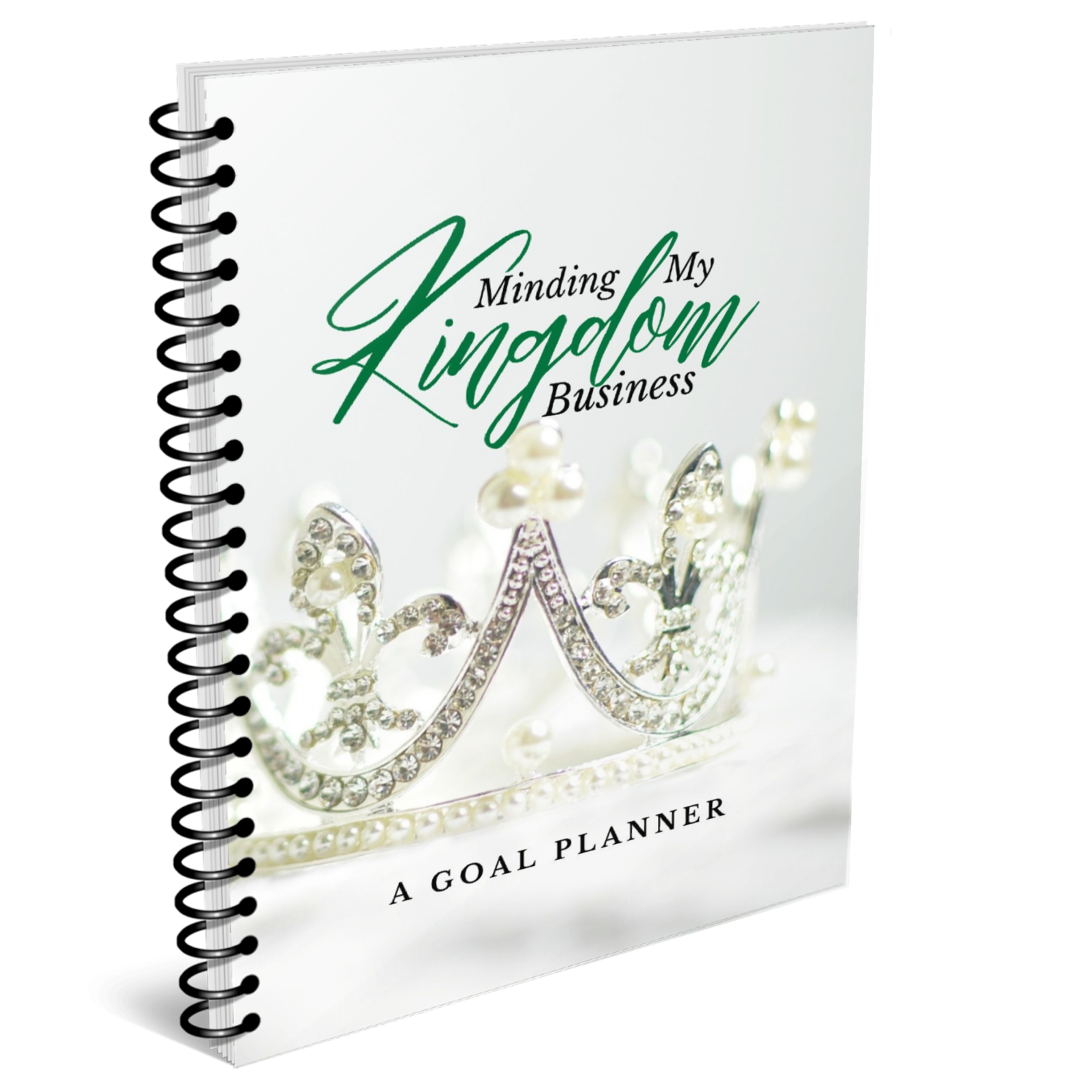
Durability matters too. For sustained, long-horizon planning, Minding My Kingdom Business, a goal planner is built around quarterly goal sections and reviews.
Pick Your Journal and Start With Day One
The perfect journal you never open loses to the decent one you use daily. Choose your format, set one target with a deadline, and write the first entry today.
If you want a ready-made starting point, Money Matters, a 31-day financial wellness journaling challenge walks through three levels of financial well-being, daily scripture, and practical exercises, from a full financial overview to long-term planning.

Your financial goals deserve more than a blank page and good intentions.
Frequently Asked Questions
What should I write in a financial goal journal?
Start with your current numbers: income, expenses, savings, and debt. Then write the goal itself with a target amount and a deadline, and note why it matters to you. From there, add a monthly check-in where you record what you saved, what you overspent on, and one adjustment for the next month. A financial goal journal works best when it holds both the plan and the honest review, not just the dream.
How often should I update my financial goal journal?
Weekly entries take about ten minutes and keep spending visible before it drifts. Add a longer monthly review where you compare actual savings against your target amount and adjust the next month's plan. Quarterly, step back and look at your long-term financial goals.
Can a bullet journal help with financial planning?
Yes, if you are willing to draw your own trackers. A bullet journal gives you total flexibility: you can build a savings tracker, a debt payoff page, and a spending log exactly how you want them. The trade-off is setup time and the blank page problem. If you have abandoned blank notebooks before, a structured financial goal journal with prompts and review pages removes that friction and keeps you moving.
What is the difference between a financial planner and a financial journal?
A financial planner is a person, or a dated calendar, that maps out what you intend to do. A financial journal is where you reflect on how it is actually going: the prompts, the numbers, the scripture, and the honest notes about why you overspent. Most people need both. The journal is what keeps the plan alive between reviews, which is why choosing the right journal for financial goal setting matters as much as the plan itself.
